
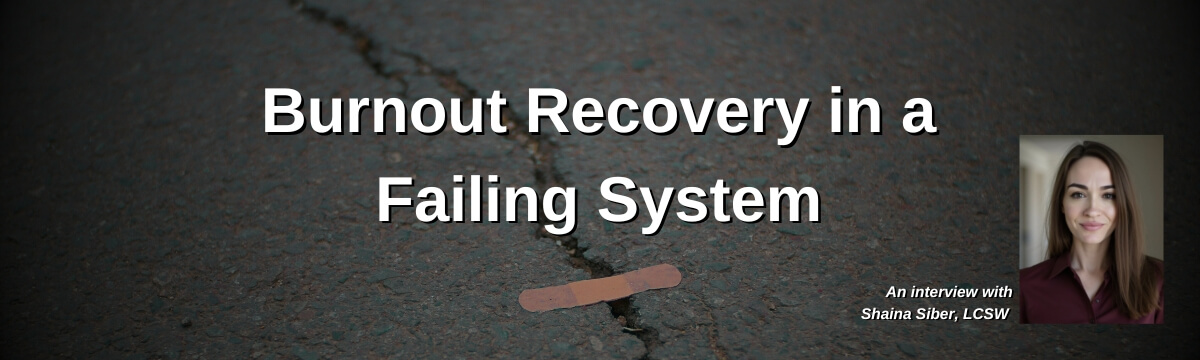
Burnout Recovery in a Failing System: ACT, Moral Injury & Reclaiming Agency – An Interview with Shaina Siber, LCSW
Curt and Katie talk with Shaina Siber, LCSW, about what it means to practice therapy in a system that feels increasingly unstable. From economic volatility and moral injury to burnout as a fawning trauma response, Shaina shares how therapists can move from control strategies to agency using Acceptance and Commitment Therapy (ACT) and Compassion-Focused Therapy (CFT).
Click here to scroll to the podcast transcript.Transcript
(Show notes provided in collaboration with Otter.ai and ChatGPT.)
About Our Guest: Shaina Siber, LCSW
 Shaina Siber, LCSW is the founder of Affirm Mental Health, host of The Affirming Minds Podcast, and author of the forthcoming Routledge book Using ACT and CFT for Burnout Recovery: The Beyond Burnout Blueprint (available for pre-order February 25, 2026; official release March 2026).
A graduate of New York University, where she earned both her BSW and MSW, Shaina brings over 15 years of clinical and leadership experience. She previously served as Director of Ambulatory and Emergency Psychiatry at Montefiore Medical Center in the Bronx, where she led program and curriculum development initiatives alongside her clinical and administrative responsibilities.
Shaina is the recipient of the 2025 Champions of Evidence-Based Psychological Interventions Award from the Association for Behavioral and Cognitive Therapies (ABCT), recognizing her dedication to advancing evidence-based psychological care.
Her work centers on trauma-informed, LGBTQ+, and culturally responsive care, equipping clinicians and organizations with science-backed strategies to prevent and recover from burnout, cultivate resilience, and build values-driven lives.
In this podcast episode: Burnout Recovery in a K-Shaped Economy
Therapists today are navigating hiring freezes, wage stagnation, insurance instability, identity-level threats, and mounting systemic uncertainty — while supporting clients experiencing the same instability.
Shaina describes a climate of “hyper-normalization,” where everything appears business-as-usual while systems strain under political, economic, and cultural pressures. In this environment, burnout isn’t simply about workload — it may be a trauma response.
This episode explores:
- Burnout as a fawning response to unsafe or toxic systems
- Moral injury in modern mental health care
- Psychological flexibility as a recovery tool
- How to move from overcontrol to agency
- Compassionate prioritization instead of performative self-care
Key Takeaways for Therapists on Burnout Recovery & Reclaiming Agency
“There was pervasive burnout, also a lot of moral injury at that time, and this parallel process where I was sort of trying to guide and support people through their burnout while crashing and burning really… like if I had a cardigan, it would have been on fire at that time.” – Shaina Siber, LCSW
- Today’s burnout is deeply intertwined with systemic instability, not just personal capacity.
- Many therapists are engaging in a fawning response: overworking, appeasing, internalizing blame to survive unsafe systems.
- Marginalized therapists may carry a dual burden: navigating identity-level threats while holding clinical space.
- Traditional self-care rhetoric can feel inadequate; “compassionate prioritization” reframes preservation as ethical.
- Burnout recovery requires shifting from control strategies (overfunctioning, avoidance, perfectionism) to agency.
- Agency exists in three domains:
- What you focus on
- The meaning you make
- The behaviors you choose
- You do not have to fix every injustice. Sustainable contribution often means choosing one aligned area of action.
- Psychological flexibility allows therapists to acknowledge pain without becoming immobilized by it.
“Burnout recovery is really centered on moving from control strategies to moving to agency… What can I focus on? What can I make this mean for myself? And what can I do?” – Shaina Siber, LCSW
Resources on Burnout Recovery, ACT & Compassion-Focused Therapy
We’ve pulled together resources mentioned in this episode and put together some handy-dandy links. Please note that some of the links below may be affiliate links.
Shaina Siber & Affirm Mental Health
- Website & CE Courses: https://affirmmentalhealth.com
- Instagram: @affirmmentalhealth
- Podcast: The Affirming Minds Podcast
- Book (Pre-Order 2026): Using ACT and CFT for Burnout Recovery: The Beyond Burnout Blueprint
Concepts Discussed
- Acceptance and Commitment Therapy (ACT)
- Compassion-Focused Therapy (CFT)
- Moral Injury
- Psychological Flexibility
- Conscious Capitalism
Relevant Episodes of MTSG Podcast
- Choosing Yourself as a Therapist: Strategies to address burnout, compassion fatigue and vicarious trauma, An Interview with Laura Reagan, LCSW-C
- The Burnout System
- Addressing the Burnout System
- Burnout or Depression
- Are You Burned Out or Are You Bored?
- Are You Too Burned Out to Work? An ethical assessment of therapist burnout and impairment
- Navigating Client Crises When Your Own Life Hits Hard
- When Crisis Hits Home: How Therapists Can Survive and Support Each Other — An Interview with Jeanine Rousso
- How Therapists Can Support Community-Building in Immigrant and Marginalized Populations: An Interview with Adriana Rodriguez, LMFT
- Reacting to Regime Change: How Therapists Can Advocate for our Clients and Communities
- When Laws and Ethics Conflict: Civil Disobedience, Social Justice, and Our Role as Therapists
- How to Stay in Your Lane to Support Diversity and Inclusion, An Interview with Dr. Joy Cox, PhD
- Therapy as a Political Act: An Interview with Dr. Travis Heath
- Blog Post: Advanced Schedule Wrangling – A Key Factor in Avoiding Burnout!
- Topic: Burnout
Meet the Hosts: Curt Widhalm & Katie Vernoy
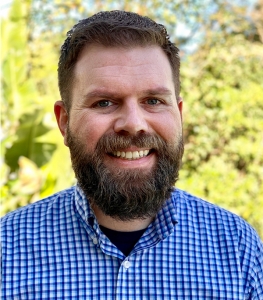 Curt Widhalm, LMFT
Curt Widhalm is in private practice in the Los Angeles area. He is the cofounder of the Therapy Reimagined conference, an Adjunct Professor at Pepperdine University and CSUN, a former Subject Matter Expert for the California Board of Behavioral Sciences, former CFO of the California Association of Marriage and Family Therapists, and a loving husband and father. He is 1/2 great person, 1/2 provocateur, and 1/2 geek, in that order. He dabbles in the dark art of making “dad jokes” and usually has a half-empty cup of coffee somewhere nearby. Learn more at: http://www.curtwidhalm.com
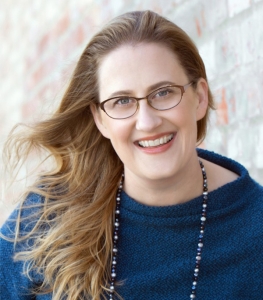 Katie Vernoy, LMFT
Katie Vernoy is a Licensed Marriage and Family Therapist, coach, and consultant supporting leaders, visionaries, executives, and helping professionals to create sustainable careers. Katie, with Curt, has developed workshops and a conference, Therapy Reimagined, to support therapists navigating through the modern challenges of this profession. Katie is also a former President of the California Association of Marriage and Family Therapists. In her spare time, Katie is secretly siphoning off Curt’s youthful energy, so that she can take over the world. Learn more at: http://www.katievernoy.com
A Quick Note:
Our opinions are our own. We are only speaking for ourselves – except when we speak for each other, or over each other. We’re working on it.
Our guests are also only speaking for themselves and have their own opinions. We aren’t trying to take their voice, and no one speaks for us either. Mostly because they don’t want to, but hey.
Join the Modern Therapist Community:
Podcast Homepage | Therapy Reimagined Homepage
Facebook | Facebook Group | Instagram | YouTube | LinkedIn | Substack
Consultation services with Curt Widhalm or Katie Vernoy:
Connect with the Modern Therapist Community:
Our Facebook Group – The Modern Therapists Group
Modern Therapist’s Survival Guide Creative Credits:
Voice Over by DW McCann https://www.facebook.com/McCannDW/
Music by Crystal Grooms Mangano https://groomsymusic.com/
Transcript for this episode of the Modern Therapist’s Survival Guide podcast (Autogenerated):
Transcripts do not include advertisements just a reference to the advertising break (as such timing does not account for advertisements)
… 0:00
(Opening Advertisement)
Announcer 0:00
You’re listening to the Modern Therapist’s Survival Guide, where therapists live, breathe and practice as human beings. To support you as a whole person and a therapist, here are your hosts, Curt Widhalm and Katie Vernoy.
Curt Widhalm 0:12
Welcome back, modern therapists. This is the Modern Therapist’s Survival Guide. I’m Curt Widhalm with Katie Vernoy, and this is the podcast for therapists about the things that go out in our practices, the things that go on in our profession, and maybe the one profession that needs to keep a professionally eerie calm while pretending that the world around us is not burning down and crashing in every particular way when it comes to things like the job market and new ways that burnout is happening and we’re all supposed to just maintain professionally manicured cardigans. And in being able to help us with today’s conversation about the world that we’re in and some of the issues that therapists face, we are joined by Shaina Siber, LCSW, to talk about maybe there’s some guiding hope for people entering into this. So thank you so much for spending some time and joining us today.
Shaina Siber 1:12
Yeah, I’m so happy to be here. Thanks for having me.
Katie Vernoy 1:16
I’m really excited about this conversation, although I’m not sure what a well manicured cardigan is. But before we get into that and other parts of this conversation, I want to ask you the question we ask all our guests, which is, who are you and what are you putting out intothe world?
Shaina Siber 1:32
Sure. Hi, I am Shaina Siber. I use pronouns, she hers. I am a clinical social worker. I’m an integrative therapist, currently living in Arizona. I maintain a full time private practice, primarily working with healthcare workers at the moment. I did spend most of my career living and working in the Bronx in New York in community mental health and hospital settings, in various clinical and leadership roles. And in 2020 I was the director of ambulatory psychiatry and emergency services in a major hospital in the height of covid and the Bronx was sort of considered a hot spot within a hot spot. And a lot of the systemic inequities that have historically plagued the Bronx and the Bronx Community really sort of surfaced. And you know, our hospital system and the community at large was quite devastated. One of the interventions at the time is I worked with colleagues to develop a rapid crisis mental health response for the hospital staff there, and began treating many of them clinically. And there was pervasive burnout, also a lot of moral injury at that time, and this parallel process where I was sort of trying to guide and support people through their burnout. While crashing and burning, really like if I had a cardigan, it would have been on fire at that time. And I think that sort of convergence really has crystallized my passion for burnout recovery, which has shaped a lot of my work for the past five years. And, you know, I think something else is just that I really want to put out into the world, trauma informed care, culturally humble and structurally responsive care, which I think is really increasingly important to me. I grew up with a lot of relative privilege because of my social and physical location, but also experienced a lot of significant interpersonal trauma. So I had a lot of interface with both social workers and the mental health system at large, and a lot of it was not helpful, but also harmful. And working in the Bronx really showed me how systemic oppression can compound that harm even further in in systems that are supposed to provide care. So I believe what we do as therapists is so incredibly healing and has that potential. So I think just putting things out that are affirming, non pathologizing, rooted in compassion, that’s kind of my jam, and what I’m trying to put out there.
Katie Vernoy 4:00
Nice.
Curt Widhalm 4:02
So, Katie and I have been practicing for a couple of decades each now. We’ve seen some various iterations of the way that the career has looked, the way that the job market has looked. At various points it has been, hey, we need more mental health workers, and trying to get mental health out there, and then covid hit, and it seemed like everybody could throw up a shingle and fill a practice with telehealth clients. And now we’re in a world where there’s a lot more VC companies. So can you talk about this from your perspective of what therapists should see in the current job markets, and how that’s kind of affecting entry into the field, and how this is leading to some of the burnout that you’re referring to.
Shaina Siber 4:47
Yeah, I heard the current labor market coined the bed rot labor market, and I think for the Gen Zers out there, that has, like, a lot of resonance, because there’s this pervasive stagnation that is happening in in response to a lot of the broader economic and political volatility that we’re experiencing. So we’re seeing sluggish hiring, hiring freezes, wage stagnation in a huge way. So people are not getting, you know, cost of living raises, many times, certainly not getting sort of performance based raises. It’s hard to move and get promoted within companies, and there’s often these soft layoffs that are disguised as restructuring and role reassignment. So I think there is a climate that’s happening, you know, in healthcare, certainly, that’s happening. A lot of health community, mental health and healthcare agencies are suffering because of change in sort of public health insurance policy and sort of anticipating for a lot of what’s going to be happening in the ACA marketplace. But I think there’s a lot of stuckness that’s happening for folks right now that’s causing some distress and uncertainty. And I think just this broader idea that you were sort of touching upon is we, you know, economists are calling it sort of this K shaped economy. So there’s people like wealth holders and corporations and certain high skill and lucky sectors that are continuing to raise sharply, while most Americans are remaining flat, kind of sliding down, and we have this kind of like economic gaslighting, where we’re getting these messages that the stock market is strong and corporate profits are rising, but that is not the lived experience of most Americans. So I think that is sort of the the if I had to take a temperature check, a lot of people are feeling some demoralization around that, especially because we live in in the US I’m talking to, maybe your listeners, in the US that work is so correlated with our identity. When you ask that question, who you know, who you are, who are you? My my impulse is to say what I do, what I do professionally, and we get a lot of messages that we the social mobility is available to us if we if we work hard enough and we try hard enough, and if we are falling behind, it means you’re you’ve failed, and that you’re you’re not doing enough, and I think people are sort of recognizing there is this, this mismatch from a lot of that social conditioning that’s been internalized with the the lived reality and and trying to reconcile those things. So I think that’s kind of where we are.
Katie Vernoy 7:39
I’ve not heard the bed rot economy. That’s so apt. I think the the topic that we’ve raised here is very layered, especially for therapists, because we are workers. There are some of us who are in agencies, organizations that may have been impacted by the government shutdown for those of us in the US, as well as potential impacts of insurance. And then we’re also working with clients who potentially have been laid off and or are stuck looking for a job and trying to compete with hundreds or 1000s of other people for a handful of jobs. And so it seems like, although very different, there might be some parallels. And please correct me, because I may be wrong here, because I don’t know, but I’m just thinking out loud a little bit. There seems to be parallels with covid. That there’s so much happening that is outside of our control, and our clients are coming to us, and we’re not able to do a whole lot. We can help them cope. But when you mentioned moral injury, and of course you did, it just seems like we might be stuck in a similar spot where things are very volatile and the workforce is K shaped, apparently, which is that makes so much sense. Hadn’t heard that before. What a therapist need to know to support clients right now, to to support themselves right now, with the economy in the way that it is?
Shaina Siber 9:17
Yeah, no, I couldn’t agree more that there is a lot of a feeling that’s eerily similar to covid in that the the uncertainty is so pervasive, and there’s this term hyper normalization that it was coined to describe the late Soviet Union, when sort of all of these systems were failing and collapsing, but this, there was sort of this performance of normalcy, right? Like, I think this Curt, what you were really describing, of, like everybody, like, button up your cardigan, like, you ever see that meme with the dog that’s like, in the room on fire? Like, this is fine, you know?
Katie Vernoy 10:00
This is fine.
Shaina Siber 10:01
So we as therapists and our clients that we’re working with are getting this message that like, it’s it’s business as usual, and in the background, there’s climate disasters, there’s gun violence, there’s dehumanizing immigration policies, there’s, you know, legislative attacks on the transgender community, there’s an anti science climate, there’s defunding of public health and education. There’s DEI rollbacks. I know I sound like that Billy Joel song, like we didn’t start the fire. It just like goes on and on and on.
… 10:32
(Advertisement Break)
Shaina Siber 10:32
So I think that we as therapists, especially us in these caregiving professions, but about so many of the people we’re working with, where they’re we’re overwhelmed. We have a level of cognitive crowding that there’s just a saturation point where it’s really hard to take on more. There’s an incredible amount of emotional distractibility. We can’t even sort of process one tragedy before we sort of have to get, you know, kind of tolerate another. So I think what’s really happening now that we have to be sensitive to and we can kind of intervene around, I think it’s been really interesting. I’m hearing people increasingly talk about burnout through the lens of the fawning response. So in trauma physiology, when we talk about, you know, fight, flight, freeze, but when we were thinking about, like complex and persistent trauma, we’re talking about from an attachment perspective, that at some point when things, the system, our caregivers are unsafe in a persistent way, we do what we need to do to appease a toxic system or, you know, and I think we do that through overworking, we do that through people pleasing. We do that through internalizing, through shame and self criticism. So I think that’s a lot of what’s happening now. And I think as therapists, we can be cognizant when we’re doing it to ourselves and just be like, Hell, no, this is the system. These are systemic issues. And, but, and, but, I think I just naming that, I think can be really liberating, and understanding the process that’s happening, and understanding that for for a lot of us, and for, you know, again, I sit with a lot of privilege from my social position, but a lot of people need to be in their in their sort of survival modes right now, and sort of honoring that, and also figuring out where is like the choice and agency and compassion that’s available within within those spaces.
Curt Widhalm 12:35
How does this look for a lot of people in their day to day lives in our field. The what does this look like in private practice? What does this look like in community mental health settings for ways that you’re seeing people respond and getting to this place? In other words, for our listeners out there who are working, what are the signs that you’re asking them to say, Hey, are you noticing yourself doing this? Maybe you consider that you’re actively engaging in this system in this way that’s leading to burnout.
Shaina Siber 13:08
Yeah. I mean, I would, I would kind of want to start by saying, you know, just a special shout out to my my peers communally, that are sort of having the profound dual burden right now of being therapists and then also sort of personally facing these identity level threats of whether this is therapists of color or LGBTQ therapists. You know, therapists that are immigrants, have families that are immigrants. I think that there is and Katie, as you mentioned, this parallel to covid, right? That we were like all affected by covid, living through covid, and having to support people through covid. So I think that that sort of recognition of that therapists of color, LGBTQ therapists, anybody who’s sort of within a marginalized identity that is sort of being attacked right now is being asked to do a lot, being asked to do so much. And I think if you are living in that embodied experience and that you think that it’s normal to carry the same exact workload in the same exact way as if all of these other structural things were not happening, I would get really curious about that, and I think probably maybe your boss is telling you that’s the expectation, and nobody’s modifying that for you. But I would say I would have a lot of pushback from this place that that’s realistic to ask you to carry everything out with that same intensity when you rightfully are in probably a state of justified vigilance, and that is going to take some of your capacity. So I think there’s a lot of compassionate intervention that that needs to be done there. I think just a lot of therapists are going to lose their health insurance around these ACA cuts, a lot of private practice practitioners, people in group practice that don’t get health benefits from the group practice providers. I think that we have to recognize we are have faced the same vulnerability if we do not have access to mental health care and physical health care. So I think those are things that just, you know, you know, getting curious about and really looking at. I like to, I think there’s such terrible words for for self care. I think they all innately sound like selfish in this negative way. So I really try to encourage people to think about, like, compassionate prioritization and self as a a very high considering factor in evaluating what needs to be priority prioritized right now, I think we need to all be incredibly discerning and protective of our energy. Because, you know, in this AI climate, I think I know that, you know, our field is there’s a lot going on there in terms of the fears about the encroachment of AI in our field, but I, you know, optimistically, really believe our field will survive, because I think compassion and humanity cannot be replicated fully by AI, and I think that’s what we all have to be so fiercely protective right now, that that sort of energy that we, that we bring, and kind of thinking about how to do that.
Katie Vernoy 16:30
In some of the conversations I’ve had, whether it’s, you know, in a Facebook group or with a consulting client, there’s been the balance of what you’re talking about, which is, I have a marginalized identity, and I have a community that greatly needs me, and so I’m going to sacrifice in different ways. And then there’s also the understanding of the toll that is being that is being taken or been, you know, been inflicted upon the marginalized identity, or the person with the marginalized identity that they don’t have the same capacity, or were not able to show up in the same way. And so there’s this conflict between almost solving the access issue ourselves and/or being able to take care of ourselves. And so it seems like this really hard balance, and especially in times of crisis or fear or I really, I appreciate the the the fawning burnout response, where we’re trying to just allow things to be normal, to try to stay under the radar, to do whatever we need to do to survive. I think it can be a very hard balance to strike, and it can be hard to know what should I be doing right now for my for myself, or for the compassionate prioritization, or for the people who really need my help. And so how do you sort through that when you’re making decisions about what you do for yourself or how you might advise someone else who’s stepping forward and saying, I have very little to give because of what’s going on in the world, and yet, I feel called to give everything I have to the people like me who need my support.
Shaina Siber 18:22
Yeah, no, I think it’s a really powerful question, and I think highly personalized. I want to kind of maybe talk through my thinking how this has looked, and hopefully people can take from it what is helpful and leave the rest. I think that there’s been a lot of misnomers around self care. The roots of self care actually quite collectivist, and come from black liberation movements, and they’ve been sort of co-opted through a lot of lenses of consumerism, around this thing of consumption. But I do think it’s and there’s nothing wrong with consumer some consumer based, you know, self care. I love a massage. I love a bubble bath. I’ll take it any day, but, but when we kind of think about healing, right? I think that when we do things that are meaningful and purposeful, it is self care. So sometimes that contribution can be self care and sort of recognizing that when we are in threat, when we are in a threatened state, when we are sort of actively over ridden with cortisol and adrenaline, we are positioned to do only a few things, and the behavioral repertoire that we have available is fighting, freezing, fleeing, fawning, flopping like that’s it. That’s what we can do when we are sort of in that highly acute, threatened state. So what I would say is the way that I look at it first is checking in with myself. And I’m saying if I am in a chronically activated state of threat, the best way that I could position myself to serve people is to inwardly look at how to down regulate my threat system. And I that might take a day, that might take an afternoon that might take six months, depending on what is going on for me, and then I think I can see my contributions that is meaningful to me, of like giving back to a community as an act of self care, but I can only do that when I am not in a acute state of activation. So that is something that I I sort of get curious about, and then I also think about, there’s a lot of within the field itself, and, you know, I’m a social worker, there’s a really strong, powerful undercurrent of social justice in the field, which is incredible. But I think there’s also been a lot of, like, sort of a scrupulosity around it, like a moral righteousness, that we have to do things perfectly, and we have to do everything, and with the volume of chaos coming out of us, it is just we’re set up for failure. And I think a lot of people disengage because they can’t do things perfectly and they can’t do it all, and they feel like if they step into a space of service and contribution that it’s never going to end, because the need is unlimited. So I think also being able to go to a place do a lot of act work, and we talked about concept of committed action, value based committed action, and really dosing this and titrating this and pacing this. And I do one small thing, right? So of all of the chaos that’s going on right now, I, based on my my area of expertise, what I know best, I am best positioned to talk about things in the space of gender affirming care. I have the knowledge, the education, I’ve done a lot of clinical work. I’m cisgender person who has the capacity right now to do that work, because I am not personally under attack in my identity. So that is the space where I am showing up. But if I had to do everything that I care about, like the DEI rollbacks and the immigration I would collapse under that I couldn’t meaningfully contribute. So I think sometimes also pick one small thing where you can show up and you can contribute.
… 22:27
(Advertisement Break)
Curt Widhalm 22:29
I’m almost hearing the callback to you were talking about the K shaped economy earlier, and well, that deals a lot with money and wages and that kind of stuff. That there’s also a K shaped economy around the care that we can give as people, and the values that we’re able to actually put out into action. And there isn’t universal action that any one of us can take. And I’m really glad to hear other people like yourself saying there is just take care of what you can take care of and be able to have realistic expectations of yourself. And this is a good reminder to our audience to come back to that thought. Because especially in the work that we do, where we’re facing a lot of our day in, day out, work with clients who, even when we do get some of that momentum going, for one, they’re then replaced by another client who’s in crisis or something like that. So I don’t know that I have a question here, other than just I hear you.
Shaina Siber 23:35
Thank you, and I’m all heard by you. And, no, I think it’s a great insight. You know, I think this is it’s coming up all the time. And I think that, you know, I think some, some of us are lucky enough to be less burdened by what’s happening right now than others. And I think if you have the capacity to do more, certainly do that. But I think also shaming and blaming and judging ourselves for not having unlimited capacity also can be sort of this internalized pressure that happens when you’re in a caregiving profession. So just being sort of cognizant of it.
Katie Vernoy 24:13
With the with your expertise in burnout, recovery and the the unique burnout that you’re describing, can you talk through what it looks like to actively engage in burnout recovery, because I, I know we we’ve Curt and I’ve talked about optimal performance and ways to try to prevent burnout, and the things that we can set up on a day to day basis. But even with that, with the amount of moral injury and chaos and grief and trauma that I think a lot of us are facing right now. I don’t know that we’ve been able to prevent it, and so looking at today’s burnout and what burnout recovery can look like now, I think that would be pretty helpful for our audience. So if you could talk through what that what that means.
Shaina Siber 25:00
Yes, yeah, absolutely. One, I would say there’s two sort of theoretical modalities of compassion focused therapy and act that I use in a lot of my clinical work, and they’ve really been sort of lifelines for me personally as well. And just to distill them to their two primary components, one is psychological flexibility. So I think we need psychological flexibility in today’s world, and that is is sort of just this idea that we can be with the pain and distress of what’s going on in our world as it is, and meet it with without judgment or defense to the extent that that’s possible, and pursue value based action in the direction of the type of life we’re trying to build. Right so a lot of what that process is about is not acceptance in the idea that we accept unworkable systems, that we say racism, sexism, ableism, any of these, these structural social hierarchies are acceptable, or cruelty is acceptable, but recognizing that an acknowledgement of being what is now sort of like the the compassionate action of noticing like this, this is what we’re dealing with. This is where we are, and then recognizing what the choices that is available to us. A lot of the ways that burnout manifests is trying to get control, trying to sort of overwork, outwork, outrun, out to do list, whatever sort of or avoid, like, hide from, you know, kind of lock ourselves in the office, close the door, drink a glass of wine, pretend my 100 notes are in there, whatever that kind of shows up for you. And there’s this, I think burnout recovery is really centered on moving from control strategies to moving to agency, and I see agency functioning in three domains, which is in any given moment, no matter what your context is, what is the choice available to you in what you focus on, the meaning that you make of what’s happening now, the meaning isn’t the automatic thought you have about it, the you know, the negative evaluation, the self judgment that comes up right away, that’s sort of, what is the intentional interpretation that I’m going to take from what’s happening, how what I’m going to make of this experience, and then the behaviors, what are the habits, the choices that you’re going to make in any given moment? And I think that is important, because we don’t all have the same choices, right? And so I think when we talk about inequity, we sort of talk about things as if we all have the same level of control in our lives, which we don’t. I think oppression, by design, it reduces and contracts people’s choice and freedoms and ability to choose. But I think that when we can access psychological flexibility in any given moment, we can say, What can I focus on? What can I make this mean for myself, and what can I do? And sometimes doing like the behavior is doing nothing, is saying there’s nothing I could do about this, right? So I’m gonna, I’m gonna say, like there there’s nothing more for me to do. I’m giving myself permission not to do anything, which I think, for I know, for me that is half the work telling myself like, stand out, there’s nothing else to do. Yeah.
… 28:27
(Advertisement Break)
Curt Widhalm 28:29
For a lot of our audience that is pre licensed and might have even less of an agency in working in this field than others, because of bureaucratic hoops, because of licensure requirements, if they are coming from traditionally marginalized communities. What’s the hope? This, this is a time in the field where a lot of us haven’t really come up with answers in this, so I’m relying on you of being the hope for our audience here to be able to say it can feel really overwhelming. This is what being able to follow all of Shaina steps actually can turn into.
Shaina Siber 29:12
Yeah, no pressure at all. Right.
Curt Widhalm 29:13
Not at all. Nope.
Shaina Siber 29:17
I know I am self aware enough to recognize in the course of the conversation. You know, I’ve probably been quite the debbie downer in a lot of ways. And, you know, I will own that. And I am, you know, almost like outrageously optimistic about our field. I’m sort of outrageously and enthusiastically passionate about being a therapist and what we do. So I think for those people who are not licensed and sort of maybe on the fence, what I would say is there, there’s a need, you know, and if there is, you know, I think meaning and contribution are something that are important to you. There is so much of that possibility in this field, I think we haven’t done enough to safeguard our workforce of clinicians. That we have put the burden on self care so exclusively and squarely on their shoulders, really, to our field’s own detriment. So I think that going in with with open eyes and finding ethical practices and finding you know resources that are aligned with your values and speak to you and clinical communities that speak to you, I think our field is moving more to non pathologizing trauma informed practices. And I think that is helpful. I think our field is building more structural awareness. That is helpful. These things take time, and I think a lot of the progress has been halted because of what’s going on right now in the current political administration and otherwise. But I, you know, I think there’s, like, this really corny quote I always come back to of, like, you know, the the oak tree is in the acorn. So I, that’s how I sort of feel about our field. Like, all the possibility of potential is, is there. I think that we attract people that want to contribute to meaningfully to the world, but I think it’s just like recognizing you’re gonna sort of be a part of, like building the ship while you’re in it, you know. And I think if you if that’s something you can tolerate, then I think your your services would be appreciated.
Katie Vernoy 31:38
I think the question that I have is kind of to close this up, because we’re getting close on time is looking at the future of work and care, and how can that evolve to better support people’s well being? Because it feels like you’re saying there are possibilities. There’s things that are already happening. But if you could design, if this is a miracle question, if you could design the perfect workforce, what would that look like?
Shaina Siber 32:03
So I really love the work of John McKay, who is the owner of Whole Foods, of all things. He wrote a book on conscious capitalism, and it’s talking about using the infrastructure that we have for the collective good. So how do we move from models of extraction? I think sometimes people like, you know, capitalism, of course, especially late capitalism they’re in, has a really bad rap of, like, all of the inequity that it can populate. And I’m not arguing that, but I think it could feel overwhelming to say, like starting over from scratch. So I think having a model that it has four pillars that I think are really central. One is on higher purpose. So basing organizations on mission that are beyond profit alone, stakeholder orientation. So moving away from just, you know, shareholders being considered to employees, customers, communities, suppliers, the environment being considered in decision making is critical and part of the responsibility of a business. Conscious leadership. So compassion and integrity and self awareness, they’re not like sort of add ons or nice to have. They are integral in a conscious culture, which means that we’re, you know, consciously cultivating fairness and transparency and trust, and there are conditions where people feel valued. So that’s a model that, you know, if you look at there are models that are, this is being lived out, or blueprints of businesses that are are doing this in big and small ways already, you know, like, Hello Costco, Hello Ben and Jerry’s, you know. And I think that’s a that’s a blueprint for all of us, and really runs counter to the cruelty that is, you know, really harmfully being modeled as like a pillar of leadership strength right now. So that’s, that’s not my independent idea, but I am a proponent and an advocate for conscious capitalism. I think that could be a real way forward for us that is actually feasible.
Curt Widhalm 34:10
I want to thank you for your time today and give you an opportunity to tell our audience where to find out more about you and about the work that you’re doing.
Shaina Siber 34:19
Oh, thank you so much. Well, I wrote a book. I’m very passionate about this, so it’s all been put to word called Using ACT and CFT for Burnout Recovery with Routledge. So that will be available for pre order in 2026 and I would be so thrilled if you gave it a read. I do run an accredited continuing education company, so called Affirm Mental health. So you could go to affirmmentalhealth.com and check out our membership and our courses that are all about, you know, all of the things I describe that I’m trying to put out into the world. Follow me at affirm mental health on Instagram, and I have a podcast called The affirming minds podcast, most of our episodes are CE eligible. So you know, give that a listen.
Curt Widhalm 35:04
And we will include links to all of Shaina’s stuff in our show notes over at mtsgpodcast.com. Make sure that you follow us on our social media. Join our Facebook group, the Modern Therapist Group, to continue on with this and other conversations. And until next time, I’m Curt Widhalm with Katie Vernoy and Shaina Siber.
… 35:23
(Advertisement Break)
Announcer 35:24
Thank you for listening to the Modern Therapist’s Survival Guide. Learn more about who we are and what we do at mtsgpodcast.com. You can also join us on Facebook and Twitter, and please don’t forget to subscribe so you don’t miss any of our episodes.




SPEAK YOUR MIND