
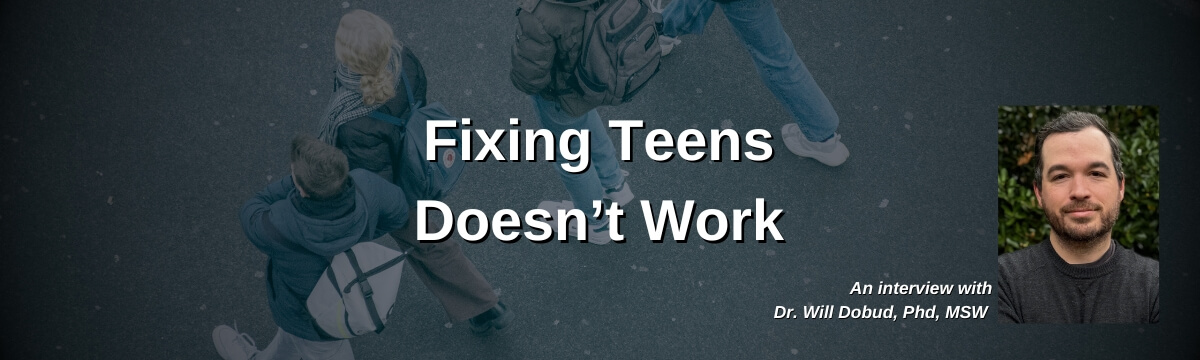
Why Fixing Teens Doesn’t Work and What Actually Helps Youth Mental Health: An Interview with Dr. Will Dobud
Curt and Katie chat with Dr. Will Dobud about what therapists often get wrong when working with teens, why adolescent behavior is so often overpathologized, and how social connection, play, discomfort tolerance, and mastery can better support youth mental health.
Click here to scroll to the podcast transcript.Transcript
(Show notes provided in collaboration with Otter.ai and Claude AI.)
About Our Guest: Dr. Will Dobud, social worker, researcher, and educator
 Dr. Will Dobud is a social worker, researcher, and educator who has worked with adolescents and families in the United States, Australia, and Norway. Will is from Washington, D.C., and divides his time between the United States and Australia each year.
Will is an award-winning researcher and educator who has received recognition for excellence in research, teaching, and crime prevention. Dr. Dobud is a Senior Lecturer in Social Work at Charles Sturt University, Australia’s largest social work school. Will is an invited international speaker who conducts workshops for therapists and families around the globe.
Will’s research focuses on improving therapy outcomes for teenagers and promoting safe, ethical practices. He has investigated and written about America’s Troubled Teen Industry, especially wilderness therapy. He has worked alongside advocates, survivors, researchers, and clinicians to protect youth from institutionalization and harm.
In this podcast episode: Teen Mental Health, Therapy Engagement, and Adolescent Development
Curt and Katie invited Dr. Will Dobud to unpack what therapists, parents, and systems often misunderstand about adolescents. This conversation looks at the so-called youth mental health crisis, the limits of overmanagement and overdiagnosis, the loss of play and third spaces, the role of loneliness and disconnection, and how therapists can better support teens by focusing less on fixing them and more on helping them engage, connect, contribute, and build mastery.
Key Takeaways for Therapists on Teen Mental Health, Connection, and Mastery
“At times, I think we’ve overcomplicated something that could actually be much more simple. And so when I read things like adolescents are the hardest to engage in therapy, there’s a bit of me that thinks maybe you’re trying too hard.” – Dr. Will Dobud, social worker, researcher, and educator
- Teens are not just adults with smaller bodies. Youth therapy requires attention to child development, play, interaction, movement, and engagement, not only sitting and talking. Dr. Dobud specifically pushes back on the idea that therapists can just take adult models off the shelf, make a few adjustments, and call it youth therapy.
- Some adolescent behaviors that worry adults may be developmentally normal and should not automatically be pathologized. He cautions against the “othering” of youth and the tendency to treat normal kid and teen behavior as evidence that something is inherently wrong.
- The perception of a youth mental health crisis may be shaped by both real distress and increased screening, labeling, and intervention. The conversation explores how more screening can inflate rates while also acknowledging genuine concerns like loneliness, self-harm, and suicide risk.
- Social disconnection, fewer third spaces, less unstructured play, and adult overmanagement may be major contributors to youth distress. The episode highlights how kids need more room for risk, conflict, creativity, and unsupervised play in order to develop confidence and resilience.
- Young people will seek connection wherever they can find it, including social media and AI relationships, especially when secure human connection is missing. Rather than centering moral panic, Dr. Dobud reframes the issue as a social connection problem.
- Therapists can support resilience by helping youth internalize success, mastery, autonomy, and contribution rather than over-directing them or solving everything for them. He describes mastery as one of the most important developmental experiences adults can help create.
- Asking teens what they think, what they want, and how they made decisions can be a powerful intervention in itself. This part of the conversation speaks directly to helping young people become thinkers, not just doers.
“If they’re starving for connection, they’re going to gorge elsewhere on something else.” – Dr. Will Dobud, social worker, researcher, and educator
Resources on Youth Mental Health and Teen Therapy
We’ve pulled together resources mentioned in this episode and put together some handy-dandy links. Please note that some of the links below may be affiliate links, so if you purchase after clicking below, we may get a little bit of cash in our pockets. We thank you in advance!
- Website: www.willdobud.com
- Dr. Will Dobud at Charles Sturt University
- Kids These Days: Understanding and Supporting Youth Mental Health
- Will Dobud’s social media
- Jane Addams, The Spirit of Youth and the City Streets
Relevant Episodes of MTSG Podcast:
- What Can Therapists Do About the Loneliness Epidemic?
- Rethinking Oppositional Defiant Disorder: Children reacting to the system around them
- Advanced Minds, Unique Challenges: Therapeutic Approaches for Gifted Children
- The Crisis in College Mental Health: An Interview with Pardis Mahdavi, PhD
- How Therapists Can Really Help Kids Who Are Being Bullied
- What is Play Therapy?: An Interview with Ofra Obejas, LCSW
- Rage and Client Self-Harm: An interview with Angela Caldwell
- Risk Factors for Suicide: What therapists should know when treating teens and adults
Meet the Hosts: Curt Widhalm & Katie Vernoy
 Curt Widhalm, LMFT
Curt Widhalm is in private practice in the Los Angeles area. He is the cofounder of the Therapy Reimagined conference, an Adjunct Professor at Pepperdine University and CSUN, a former Subject Matter Expert for the California Board of Behavioral Sciences, former CFO of the California Association of Marriage and Family Therapists, and a loving husband and father. He is 1/2 great person, 1/2 provocateur, and 1/2 geek, in that order. He dabbles in the dark art of making “dad jokes” and usually has a half-empty cup of coffee somewhere nearby. Learn more at: http://www.curtwidhalm.com
 Katie Vernoy, LMFT
Katie Vernoy is a Licensed Marriage and Family Therapist, coach, and consultant supporting leaders, visionaries, executives, and helping professionals to create sustainable careers. Katie, with Curt, has developed workshops and a conference, Therapy Reimagined, to support therapists navigating through the modern challenges of this profession. Katie is also a former President of the California Association of Marriage and Family Therapists. In her spare time, Katie is secretly siphoning off Curt’s youthful energy, so that she can take over the world. Learn more at: http://www.katievernoy.com
A Quick Note:
Our opinions are our own. We are only speaking for ourselves – except when we speak for each other, or over each other. We’re working on it.
Our guests are also only speaking for themselves and have their own opinions. We aren’t trying to take their voice, and no one speaks for us either. Mostly because they don’t want to, but hey.
Join the Modern Therapist Community:
Podcast Homepage | Therapy Reimagined Homepage
Facebook | Facebook Group | Instagram | YouTube | LinkedIn | Substack
Consultation services with Curt Widhalm or Katie Vernoy:
Connect with the Modern Therapist Community:
Our Facebook Group – The Modern Therapists Group
Modern Therapist’s Survival Guide Creative Credits:
Voice Over by DW McCann https://www.facebook.com/McCannDW/
Music by Crystal Grooms Mangano https://groomsymusic.com/
Transcript for this episode of the Modern Therapist’s Survival Guide podcast (Autogenerated):
Transcripts do not include advertisements just a reference to the advertising break (as such timing does not account for advertisements)
… 0:00
(Opening Advertisement)
Announcer 0:00
You’re listening to the Modern Therapist’s Survival Guide, where therapists live, breathe and practice as human beings. To support you as a whole person and a therapist, here are your hosts, Curt Widhalm and Katie Vernoy.
Curt Widhalm 0:13
Welcome back, modern therapists. This is the Modern Therapist’s Survival Guide. I’m Curt Widhalm with Katie Vernoy, and this is the podcast for therapists about the things go on in our profession, the clients that we serve, how we conceptualize that we’re working with them. And let’s be honest, sometimes working with kids and teens can feel less like therapy and more like trying to decipher what six, seven and skippity toilet and whatever language that kids are bringing in these days. And we know that this population, they’re our future, but there are a lot of things that just seem to get lost in the ways that therapists can work with adolescents, work with youth, and really being able to bring things along. This is a population that’s near and dear to my heart and my practice, and we’re going to cut through a lot of the noise today, and we’re talking with Dr. Will Dobud about working with youth and how therapists can conceptualize and bring a lot of this together. So thank you for joining us here today.
Dr. Will Dobud 1:23
Thank you so much.
Katie Vernoy 1:25
We’re excited to have this conversation, but before we get started, let me ask you the question we ask all our guests, which is, who are you and what are you putting out into the world?
Dr. Will Dobud 1:34
Sure. So my name is, Will. I am just a massive psychotherapy nerd, and even though my accent is a jumbled mess these days. I grew up in Maryland, just outside of Washington DC, studied social work in Maryland, was working with youth in a range of settings, from intensive outpatient to residential facilities, doing most of that in the outdoors, doing a lot of outdoor therapy stuff. I was lucky that brought me like all over the country. I worked in Alaska, a little bit, in Arizona, upstate New York, North Carolina, one of my favorite places on Earth, West Virginia. So a lot of different contexts. And then I met my my wife, and came to Australia. So I’ve been kind of zipping back and forth ever since. I think my take on youth mental health is, I don’t know if it’s unique, but I don’t know. I think sometimes we’ve over complicated, something that could actually be much more simple. And so when I read things like adolescents are the hardest to engage in therapy, there’s a bit of me that thinks maybe you’re trying too hard. And so there’s times that I think that we’ve over complicated things a little bit.
Curt Widhalm 2:46
One of the questions that we start a lot of our episodes with is not from a shaming place, but from a collective wisdom, if other people have made mistakes, sort of place, but what kinds of mistakes do therapists make in working with youth, that we can maybe help our listeners not make themselves.
Dr. Will Dobud 3:06
Sure. So one of the things, and we’ve all witnessed this over the last decade, and the rise of how we, you know, cultural awareness of social justice, and that is usually attributed to race, to gender, to cultural background. And one thing when it comes to age, it’s, it seems to me that sometimes that’s off the table, that the older somebody gets, the more likely there is to be harm in aged care facilities and and the treatment of of of older people. And that also happens the younger that people get. I think if we took the 1000 types of therapy, I think if we took play therapy, there’s not many other that were actually developed for just for children. So we think that a lot of times we’ll take cognitive behavioral therapy off the shelf and then make some tiny adjustments, and then voila, we have a youth therapy. And so a lot of times, I think that we we miss out on a lot of research from child development, about play, about interactions. We assume that, and for instance, the adolescent brain is ready to sit and, you know, talk about big, deep feelings or what’s going on in their unconscious. And we also see some literature that teaching self regulation techniques to the younger child might not be as helpful as we all think that it is. So I think sometimes it’s over complicated when it can really just be focusing on doing things together and an investment in in physical activity. I don’t mean like exercise. Like I remember when I came to Australia, I would go into residential care, care facilities, and everybody just plays uno, the card game here, and you just see kids talking and playing and and they get deeper while there’s some activity. So sometimes I think too much sitting and talking might miss the mark with some kids. And I’m not, I’m a die hard common factors person, so I don’t think there’s one therapy that is better than the others. So I think everyone’s using the therapy that aligns with them the most. I also think the labeling is getting to a place for me and and, and I don’t mean labeling or I know the mental health care system in the western world is set up around diagnoses if we want third party reimbursement. One of the things, I think there has been an othering that has happened in in the world today. When I looked at youth, and while doing my research, that youth are called fragile today, you know, the most best selling non fiction book last year, label that entire generation is anxious. And I think that this inherently goes, Look at the kids like they’re in the zoo. I talked to someone who said they called Middle School in their school district, that’s called the zoo, because the kids are so out of control and and so if you’ve othered the children, that means the children have to change to fit in with you, instead of just letting them be kids. And kids do kidsy things, and teenagers are inherently challenging, a little bit oppositional and a lot of this is actually totally natural. So I think sometimes we have to remember that there are things that the adolescent client is going to do that are going to somehow fit into the diagnostic criteria that might just totally be normal kid stuff.
Katie Vernoy 6:41
I think that there’s a renewed focus on youth. There’s a lot of at least in the media discussion about the youth mental health crisis and those types of things. And I don’t know if that’s an extension of this fragilizing of our of that generation, but what do you think is causing that quote, unquote, Youth Mental Health Crisis, or the perception of a youth mental health crisis.
Dr. Will Dobud 7:06
So I think there’s sort of two sides to this. One is the concept of whether or not some of this is fabricated, because we know that the measures we use, we’re screening more often. I mean, we just in there was data that came out of a school district in Florida just recently, looking at the data from the phone bands in the school and mental health screenings in this district, went up by 1500 students. And so the more we screen, the more numbers are going to increase. So there’s a bit of me that wonders if some of this is looks larger because of we’re testing for this stuff more often with measures like the PHQ-9, which we know has a false positive rate above 60%. We also know there’s a large study about the PHQ-9 out of England, and I think it was 2011 where for the people in the study that tested did not screen for depression, they tested, I don’t know if that’s positive or negative. They did not have depression. Over 40% of them still left with a prescription for antidepressants. So we’re intervening more, we’re screening more, and that’s going to cause this rise in numbers. So there’s a bit of me that wonders about the fabricated side. There’s also the side of we’re seeing emergency room visits for all the wrong reasons, not a kid falling off the monkey bars, but for self harm. We’re seeing how youth suicide has steadily increased over the past few decades. And so there’s that part where young people when in self report surveys, they’re saying they’re lonely. So we have this loneliness epidemic, which is should be really startling for adults, considering kids typically spend, what like 80% of the year surrounded by children and surrounded by adults at school. So something’s going on there as well, that a kid could be around this many adults and feel invisible. So I think what has one of the things that has shifted in society, and yes, social media and technology has something to do with this, but youth anxiety has been decreasing since the 1950s, so that’s far removed from just the phones. And I think it has to do with as things get more complicated. You know, all of us, we get home from work and we go, I’ll do three more emails while your child is staring at you and wanting to play, that many of us have become more siloed away in our in our life, outdoor play has decreased. And I’m not being just an outdoor sales person, but kids going out and taking risks and making mistakes, and now we have kids that are telling us they’re anxious and don’t want to go out. And you know we’re seeing you know, kids don’t drink beer anymore. Kids are having less intimate relationships. Again, not saying everyone needs to drink beer and have sex. It’s that, I think that there is something that has happened in the water, not technically, that is making it so youth don’t feel really comfortable to contribute. So I think we have a massive engagement problem, and that’s where I think therapy could help. But we have to really focus on engagement in our services, not necessarily what’s wrong with the kids all the time. Have we given them something to engage and participate in?
… 10:34
(Advertisement Break)
Curt Widhalm 10:37
It seems, in retrospect, and I have a couple of kids myself that are around middle school age. But really, it seems like the isolation that occurs because of lack of third space, the amount of even just being in activities requires, you know, extensive commitments that don’t just naturally happen. You know, the covid effects on a lot of the youth that are happening here today, it seems like so much of what’s happening is just more and more isolation and connection through devices, as opposed to many of the things that you’re talking about. My middle schooler was talking about that it’s the first time that one of his friends, you know, kind of broke a bone and got sent to the emergency room in seventh grade. And I was thinking, you know, that was a two or three times a year occurrence for kids in the classes when I was growing up. So.
Katie Vernoy 11:41
I broke my arm in second grade.
Curt Widhalm 11:43
So there just does seem to be a lot of just protecting and isolating the kids away from life that I think is part of something that we have to conceptualize as part of therapy. Is not just necessarily in our offices. Is this consistent with what you’re seeing as well?
Dr. Will Dobud 12:04
Totally. This is something that, as we started, and I think, you know, there’s part of me that looks at a lot of things that have have contributed to this. You know, when they used to put missing children on milk bottles.
Curt Widhalm 12:21
Yeah.
Dr. Will Dobud 12:21
Like that was that created a huge moral panic, as did stories of when they trick or treat, there’s going to be someone giving your kid a poison apple. And this is really easy to sort out. I remember my mother told me this, don’t take anything that’s not in a wrapper, you know, like you can solve this really quickly. And and then stranger danger, all of these things create this, this sort of moral panic. Now one thing, and I might be a total weirdo about this, and might be on the wrong, wrong trajectory with this argument. I when I heard arguments about the phones, I think you could do the exact same thing to 24 hour news, which is just bad news, bad news, bad news, bad news. We’re divided. We’re divided, we’re divided. And then if someone votes a different way than we do across the street, we sit there and go, Oh, that person. They’re a this. And I think what it did is it did take away exactly what you said, Curt, that third space is is essential to community. In many places, it could just be like the local pub and everybody gets together on a Sunday and hangs out, or club sports, for people that aged out of sports. There’s so many different ways and so kids really need more unstructured and unsupervised time to learn to play. So for instance, if kids haven’t had the chance to play house, how are they going to have a more serious intimate relationship in their adolescent years when they have real feelings and real hormones and they haven’t even played or trialed out this idea, or played shop. So really, the play is a big component of this. And then for us, as we get busier, as adults, one of the things, have we actually given kids something to imitate? Have we taught them to play? Have we, So, for instance, you know, as someone who you know has written about and been trained in solution focused as on the radio here in Australia, where it’s like the most sweeping phone bands and social media bands in the world. And people, I keep saying to them, just like the miracle question, okay, tomorrow elves come and they steal all of our phones, and there’s no more laptops and there’s no more technology. What are you going to do with your kids? And I think most adults know the answer to that. Well, we’re going to have to talk at the dinner table. Okay, so do we need federal government legislation to learn how to talk at the dinner table? Maybe, like, obviously, there’s really bad things on social media, like kids fighting. And, you know, giving your kid a piece of technology so they can invite 7 billion strangers into your home, like there’s there’s really creepy parts about it. At the same time, I think there’s something much more simple than than this new moral panic that’s happening.
Curt Widhalm 15:16
First of all, how optimistic of you to think that kids can even imagine affording a house in the future?
Dr. Will Dobud 15:23
Oh, my.
Curt Widhalm 15:23
And second, I think there’s also a parenting emphasis that kids have to get along all of the time, and that there isn’t even like, all right, you kids are arguing, playing house. Johnny is Johnny is cheating at house. Yes, you know, go, go deal with that, rather than coming in and refereeing every single interaction that ends up happening. That the parents are to blame, obviously this, but there’s a parenting aspect too, that’s just our own discomfort in having the children have discomfort.
Dr. Will Dobud 16:04
Yeah, and that’s where I when I think about the when I was saying, like, is there a youth mental health crisis, or is some of this just our own adult anxieties about about youth and them, what they experience. Like Eric Erickson, and I want to touch on covid for a second. But like, you know, we all learn Eric Erickson in our psych 101, class, and Eric Erickson talked about we learned how to stop stunting the growing body by putting kids in factories. And now we have to stop it because of our own anxieties, and learn to let live a little bit. And the blueprint for development is there, speaking on factories and linking this to covid. As an American social worker, like my profession, is eternally linked to the work of Jane Addams. And Jane Addams has a book from 1909 called the spirit of youth and the city streets. I highly recommend it, who, for anyone who’s a real social, working nerd person, very dense, hard to read and really challenging.
Katie Vernoy 17:10
It sounds awful.
Dr. Will Dobud 17:12
It’s tough. It’s really tough. But she talks about youth crime in Chicago in the late 1800s early 1900s and links it just to school and forcing kids to memorize and learn to read and learn mathematics. And she was friends with John Dewey, so she’s probably thinking of experiential education and moving around give kids things to do, and the amount of kids in the factory working in these horrible places. And there’s an interesting polling of children who worked in in America, and one of the most like awful full of chemicals, horrible conditions factory. They interviewed, like 4000 of them. Most of them said they’d rather be in the factory than go back to school, which is an interesting century ago anecdote. But one of the things that happened, and Australia was a really interesting case example of this. So the city of Melbourne, I’m in Adelaide, that’s about an hour’s flight from me, Melbourne was the most locked down city in the in the world, and so the state of Victoria had the strictest covid policies. And I didn’t think much of it. I just thought, I feel really bad for the people who are living there. That’s really tough two years. And then in 2022 and 2023 when that opened up, 40% increase in youth crime. Now, youth crime has been steadily deteriorating since like 2010 you could link that to a whole range of things, again, that could be fabricated by how we count things and decriminalizing things, but a 40% increase is a huge spike in youth crime. And as I was reading the Jane Addams stuff, I went, Oh my gosh, we didn’t give them something to participate in. And look what happened. Again, not claiming it’s just an association, not saying that’s the cause. So we do have a lot of good research, good evidence, good ideas about youth development that I think we could get a reminder in, in thinking we do have to let kids have arguments, and you can think about like a litter of kittens, or like puppies, they’re going to fight, and they through rough and tumble play. and it doesn’t have to be fighting. It’s playing through that rough and tumble play. Dogs learn mouthing where it looks like fighting, but really it’s dogs playing. And so that’s where you get a dog that you know I I’ve had one dog in my life, and so I am no expert on this, but you know, when a dog play fights with you, it’s fun for everybody, and so you know the dog’s not going to hurt you, and so you can have this battle, and then they get exhausted, and you go on your way. And so I think sometimes what looks like fighting, isn’t. But I think a lot of this many parents inherently know. And then we’ve also, like, have so many levels of bureaucracy and legislation and administrative crap that, like, I mean, where I come from, in Maryland, they banned tag on playgrounds, like the school district like. So what teacher went to university, got a degree, got a job at a school, and said, You know what I want to do with my like, 15 minute break, police tag.
Curt Widhalm 20:32
I’ll do you one more or not to not to make this a one up competition.
Dr. Will Dobud 20:37
That’s it.
Curt Widhalm 20:38
I used to work at a school that banned imagination play.
Katie Vernoy 20:44
Oh no!
Dr. Will Dobud 20:44
Come on.
Curt Widhalm 20:45
No imagining it was.
Katie Vernoy 20:49
This sounds like some sort of like dystopian movie that you’re talking about, Curt, that’s not cool.
… 20:54
(Advertisement Break)
Katie Vernoy 20:54
As I’m listening to you will. I think there’s this element of not being able to sit in discomfort, our own difficulties with conflict, and not allowing children to be able to learn how to navigate those conflicts. There’s understanding relationships and having real relationships. But, I mean, there’s a lot of different things I want to talk about, but the thing that relates to this in particular, is this idea of a whole separate type of relationship, or separate types of relationships that younger generations are having than especially mine. And so there’s the social media relationships, being in relationship with people you’ve never met before, AI relationships like character AI, or ChatGPT, or Claude or those types of things. And so there’s a lot of different ways that technology is also playing into how we interact with the world, how we interact with the people around us and even with ourselves, through, you know, some sort of a character, AI character. What are your thoughts on, on technology being folded into, well, folded into our lives? As far as as you know, just generally, you’ve already kind of mentioned that. But as far as children who are learning how to develop relationships, there are these other ones that some adults don’t have as much understanding of and as a society, I don’t believe we actually have a lot of research and data on, you know, for example, safety or privacy or or those types of things. What are your thoughts?
Dr. Will Dobud 22:34
Well, I think the technology angle is really interesting, and it’s, it’s obviously just that’s the landscape where young people are living today. And so it is deeply troubling that AI would replace a human to human, heart to heart, sort of connection. But also there has been, I think, us as therapists. I mean, what’s our product is sitting and talking to each other and so or doing something together. And I think that we could really help parents understand the importance by, you know, what we what we put out there when we work with parents and young people, that the young people are going to if they’re starving for connection, they’re going to gorge elsewhere on something else. And so they’re going to find it in like, you know, we used to talk about this with, like, gang involvement without the connection. The easiest way to get connection is peer to peer connection, instead of having an attachment based connection. So young people will seek it in any way. We see this with children, that you can put a baby on the ground, it will find mom or dad and crawl right to it. You don’t need arrows on the ground to know where connection is. But today, if there isn’t that kind of secure connection, what will happen is they will get that connection everywhere else and the tech companies, this, this is an interesting anecdote that if you listen to many popular like comedy podcasts over the last few years, you might get an Amazon advertisement, maybe a Google advertisement. I think they were the two biggest sellers of ads on podcasts when we looked at this data. Number three was better help. So, yeah, think about how much money went into comparing to Amazon, levels of money to so to go, here’s the easiest way to go and get therapy. And it’s not, you know, you’re still distance from somebody. And I’m not, I’m not poo pooing on telehealth at all, like we were miles late to that game at the same time. But so I think it’s, it’s the part of what I see as the biggest problem is a social connection problem. So it’s no surprise to me that young people are going to run to anywhere where they can find social connection. And what we know about the, the character AI and all the different AI bots is they either sort of really go over the ledge and have you know, are implying for suicide or or hurting your parents. We have all these cases about that, or it’s just giving young people everything they want, which we’ve tried that with participation trophies, or, like, not giving grades at school, or like, it’s kind of it’s reinforcing many of the things that I think many of us adults worried about youth are trying to avoid. So I’m definitely not someone who’s on on the moral panic train about social media. But again, we have to be adults in kids’ lives who give them something to imitate. So if we can’t put down our phones at the dinner table, how are we going to expect that our kids have learned this thing? Or if we haven’t taught how to play with each other or how to handle a little, you know, some discomfort, how can we expect that from our children?
Katie Vernoy 25:59
I want to go to a different point, because I think it’s related, but also I think along something that you were talking about earlier, and it’s been kind of playing in my head, and I want to make sure that I don’t forget it. But when we’re looking at whether it’s Curt’s dystopian school that doesn’t allow creativity, or there’s no tag, or there’s those types of things, the word that kept coming to mind, or there’s two words, one is helicopter, and the other one is micromanage. And I think that there’s been for years, to your point, not just with the phones, but for years, there’s been this move towards parents needing to design their children’s lives to the minute, and whether it’s, you know, elite sports or academics or this group or that group, or these types of things, it feels like there is a huge loss of the way I describe it is critical thinking, but I think there’s also independence that’s lost. If kids don’t get bored, if they don’t risk if they don’t have opportunities for creativity, we really are leaving them very susceptible to whether it’s harmful relationships and kind of being guided into an AI deep well of negativity or or just not knowing how to become an adult and not knowing how to do the things that all of us that didn’t have some of these things are able to do. And so shifting more into kind of solutions and that type of stuff, if we’re If we’re talking about a lack of independence and potentially even mastery, because they’re not able to try things. They’re told how to do things. They have parents go with them on job interviews. How are we as clinicians able to support stronger development? Because it seems like society says you need to have all of these extracurriculars and all of these things happening so that you can get into the right school, or if you’re on the on a different type of kind of socio economic status, potentially, you’re having to care for siblings, or there’s you’re having to work, or those types of things, and there’s not this free space to play, to create, to make your own decisions. And so what’s the answer? How do we solve this?
Dr. Will Dobud 28:29
Well, I actually think there’s some of this that’s, again, in some ways, a little bit simple. When we think of the over scheduling, like that’s still not unstructured play, so that’s still and I’m sounding like a like a real play based person, and I’m not. I love to play, so I’m an expert at it. So, but the other thing is, I remember reading, this is when I was doing my PhD, and I was going and visiting all these outdoor therapy programs and then all over the world, and I was interviewing people who had gone to outdoor therapy in their teenage years. And, you know, I learned all the everything about relationship, and the kids talking about, hey, you know that that therapist was really cool and nice and a real human and treated me like a person, and all the things that we that we know. At the same time, some of the literature I was reading was talking about like mastery. And I went, This sounds really familiar, because us outdoorsy people, we all look at Outward Bound, and these type of programs and Outward Bound kind of even those around since World War Two ish times, like Outward Bound when it was conceptualized by academics, how the hell does this work? This is in the 70s, they said success and mastery. So I went down this rabbit hole of success and mastery, and I found, you know, studies at Johns Hopkins by Jerome Frank, focusing on mastery with in mental health care, in inpatient treatment and where they found they could just get people doing things and attributing their success to themselves through the line of questioning from the worker, you know, how are you able to do that? You know? Have you been successful like this before? Sort of really, but giving the patient something to do. I kept going back in the 30s, one of the first child and adolescent psychiatry conferences in the proceedings, it talked about the most important thing we can do for children is give them experiences of success and mastery. So that doesn’t mean setting up all the success for them. Sometimes failing at something was still a success in the trying. So when we look at failure or just simply mastering tasks, what we want is the success and mastery internalized. So when somebody does, you know, how did you get to this appointment today? is really sometimes a huge ask for people. Where we’re we might be one step too far ahead. So loosening up the curriculum at school, loosening up the manual in the counseling room, we get the opportunity to really focus on, what are youth experiencing, and how can we help them internalize experiences of success and mastery? And then to use another John Dewey-ism, then it can be scaffolded that we can do harder things, more difficult things. So everybody learns when they’re learning guitar, they learn it one string at a time, then they learn the cowboy chords, then they learn their scales, then they you know, and it gets harder and harder and harder, but they’re only going to start getting better is if we’ve given them something to internalize, that sense of mastery, which I think reorients people, as you were saying, to far more critical thinking, because they know they have something to offer. They know they have something to contribute. So in many ways, in our recent writing, what we are writing about is just what does good democracy look like. People have something to participate in. They can contribute. They feel like their vote matters. But in a classroom that’s just about memorizing, does your opinion really matter if we’re just following the manual, are we really tailoring the world to our young people? So I think if we can keep democracy mastery what people experience in the back of our mind, we’ll start to ideally shift some of the things that we’re talking about that are all real concerns that many people are talking about.
… 32:34
(Advertisement Break)
Katie Vernoy 32:37
I’ve had a lot of young adult clients, and even some youth clients where, when I asked the question, how, how did you make that decision? Or, or how are you going to decide what to do next? Or those types of things, I’ve literally, and I know I’ve said this before on the podcast, I’ve literally had clients say, no one’s ever asked me my opinion.
Dr. Will Dobud 32:57
Yeah.
Katie Vernoy 32:58
And there’s that. And I know this is an overstatement. I know there’s a lot of different ways that people raise kids and that kind of stuff, but I worry that too much has gone to the the opposite of what you’re talking about, which is, let me dictate, let me provide, let me give you everything but the final, the very final result. And so kids might feel more like doers, not thinkers. And I think we need both to be able to be successful in life.
Dr. Will Dobud 33:27
Absolutely and Curt, you said something very resonated with me. Yesterday, I went to a meeting where young people who, I’m in Australia at the moment coming back to America at the end of the month, but there’s two Americans, and they grew up in foster care, and they one of them has come here to go to school, and the other ones come to visit. And they’re doing this advocacy work where they’re getting the organizations that work with the out of home care field, and they’re talking about the youth experience and what it’s like to be a young person growing up in this in this system. And one of the things they age everybody out of this at 18, which, as you said at the start of this, as if they’re ready to buy a house, as if the most affluent family in the world, their kids are ready to buy a house at 18, right?
Katie Vernoy 34:17
Sure.
Dr. Will Dobud 34:17
And so listening, I could see the the suits and ties in this meeting, it was all CEOs and directors of these large NGOs, and they’re sitting and I’m sitting there going, they’re squirming because the kids are saying, How come no one ever asked me what I wanted? And that doesn’t I’m not saying give kids everything they want, because they’d have ice cream for dinner every day, you know, but there is something about we, we kind of sometimes, and I think every therapist listening to this will know this. They just have to look at somebody they work with, and again, not saying to judge all the therapists, but they’ll see someone who they say they’re tailoring to what the client wants, how the client is presenting in the session, and then what do they result to? What they know best, what they do on average, and then they just stick with that. So there’s a risk of partnering with youth, because they’re wild. They want to push back at the system. They want to deviate from cultural norms. That’s a risk to adults, because it changes the way we see things. But with any risk comes the opportunity for something to go wrong, or the opportunity for something really cool to happen. So like with young people, how could I ever ask that person on a date? What if they say no? Well, what if they say yes, it could be awesome, then we can deal with what happens afterwards. So we could kind of stop over-risking everything. And thinking about risk is also sometimes risk brings a reward.
Curt Widhalm 35:53
I want to give you a chance to talk about your book, and really being able to kind of tie all of this together and fix the way that we think about youth. You know, this is the one thing everybody needs to read. Youth will be fixed.
Dr. Will Dobud 36:11
I don’t know. I don’t know if that’s true. One of the things, when Nevin and I started this book, we interviewed a bunch of experts, like we talked to my mentor, Scott Miller about therapy stuff. We talked with Gordon Neufeld, who’s like an attachment based parenting guru. We talked to play expert Ellen Beate Hansen Sandseter, who’s like a legend in Norway about youth play, risky play, rough and tumble play. And while we were writing it, we saw that the for the past decade. And I mean, I’m sure this is everything goes in circles, so I’m sure this has been going on forever. When I look at the parenting books I saw, like, tiger mom or free range kids, like, here’s the answer, make sure you’re really on your kids ass and they’re getting straight A’s or independence, let your kids go free range this. Do this. And I went, they’re always harping on one specific factor. And then when it comes to mental health, I saw this rise of, it’s just the phones, or it’s just the schools, or it’s just, you know, or you talk to a toxins expert, it’s just the pesticides. It’s just this. It’s and we get siloed away in trying to fix one thing. And so what we did is we kind of had the mantra of Youth Mental Health from 40,000 feet. That we zoomed out and looked at the big picture. And a lot of it resonates with what the conversations we’ve had that this idea of, how do you facilitate an experience of mastery? How do we really build a strong social connection in our home, in our communities, at our schools? And then the book is also, I mean, because I’ve done some research trying to tackle the troubled teen industry in the US. So the book was, we have Paris Hilton’s endorsement, which is amazing, because I know that we all know Ben Caldwell as well, and Ben wrote and said his book Saving Psychotherapy about the revenge of the clients. And what Paris did was use her platform to talk about her experience at these horrible facilities and wilderness therapy programs. And what happened 10s of 1000s of young adults came out and said, Yeah, I was also harmed at this place where all the licensed professionals were joint commission, you know, accreditations and regulation and nothing protect the children from harm. So I think there is a very it’s a, it’s a book about youth mental health for adults. So it, I think it’s challenging at times, but I think it’s a book, and this is the initial feedback. It’s only been out for a little over a month, and the initial it’s like, oh, I didn’t think about it that way. And the cool part of having interviewed so many people is we get to blame them for the controversial take. And it’s like, hey, we just spoke to them, and then we went and looked at the literature. So I hope it’s a fun read for people, and something that you know touches on a range of places where things that impact young people today, which is always constructed and facilitated by adults. So we’re looking at adults these days, not just kids these days.
Katie Vernoy 39:20
So just to kind of put a summary in, because we are very short on time, and so I don’t want to continue on, but we’ll lead people back to the book. But it seems like social connection, mastery, we didn’t talk about this, but gratitude and independence is what is going to promote emotional and psychological resilience for youth. And so I just want to say that’s what, that’s what you would be getting into if you’re reading this book. And I’m definitely going to check it out, because it seems like there’s a lot that it says, not just about youth, but also folks who are at that stage. I think developmentally, there’s some folks who are young adults, who potentially still are at that stage, or folks who were especially impacted by covid or by, you know, those different factors that we talked about, where they’re still in that more kind of adolescent phase of their life. And so thank you for for sharing that stuff with us.
Dr. Will Dobud 40:17
No, thank you for having me on. It’s been a long time coming, and a huge fan, and so it’s really excited not only to meet you both, but to come on this podcast.
Curt Widhalm 40:28
So where can people find you, and where can we link to you in our show notes over at mtsgpodcast.com.
Dr. Will Dobud 40:36
Sure. So I’m on all the social media stuff so you can, my name is pretty unique and Will Dobud so you can find that pretty easily. I’m also a pretty open book. So if anyone ever wants to reach out or talk about the book, or talk about my outdoor therapy stuff or trouble teen industry stuff, I can talk about those sort of things. And I just love connecting with people in our field and getting to know everybody and being a part of that. Yeah, reach out, connect on Facebook, LinkedIn, Twitter, X, whatever they call it now.
Curt Widhalm 41:09
What’s the name of your book?
Dr. Will Dobud 41:11
My book is Kids These Days: Understanding and Supporting Youth Mental Health. And that was co authored with Professor Nevin Harper, who’s a academic and a counselor in Canada.
Curt Widhalm 41:23
And like I said, we will include links to all of those things in our show notes over at mtsgpodcast.com. Make sure that you follow us on our social media. Join our Facebook group, the Modern Therapist Group, to continue on with this and other conversations. We’re now on Substack and LinkedIn as well. So follow us over there, and until next time, I’m Curt Widhalm with Katie Vernoy and Dr. Will Dobud.
… 41:48
(Advertisement Break)
Announcer 41:51
Thank you for listening to theModern Therapist’s Survival Guide. Learn more about who we are and what we do at mtsgpodcast.com. You can also join us on Facebook and Twitter and please don’t forget to subscribe so you don’t miss any of our episodes.




SPEAK YOUR MIND